
Author Archives: Phil Craft

Why aren’t the bees drawing out the foundation in my honey supers?

Why aren’t the bees drawing out the foundation in my honey supers? This is a frequent question that I receive this time of year. My answer is that there are just a couple of factors involved in bees making wax and drawing out foundation into comb. These factors are strong bee populations and the presence of a nectar flow. The colony with a large population has more bees available to draw comb, plus a larger number of bees foraging and returning with nectar and bee bees available for processing the nectar into honey. We can think of a hive as a factory whose product is stored honey, the comb (which the workers must manufacture) is the storage units in the factory, the nectar is the raw material that must be brought into the factory to be processed and the bees are the workers. A honey factory short of workers cannot build the required storage (the comb), plus will have a reduced number of workers available to bring the nectar in. Without a nectar flow the workers have no need of additional storage and will not build the comb.

I thus tell beekeepers that report honey super foundation not being drawn out, does your hive(s) have this strong population? Is the hive(s) full of bees? Are bees covering every frame and is all of the comb in the brood chambers drawn and being utilized in the hive for either brood rearing or honey storage? Continue reading
Ten Frames, Nine, or Even Eight in Honey Supers?

In early May, I wrote a post on the topic Nine frames or ten in the brood box? Since that discussion was confined to brood boxes, I promised a future post on the subject of the ideal number of frames in honey supers. That discussion follows.

In the earlier post, I commented that beekeepers can manage hives with only nine frames, as long as they keep in mind the theory of bee space and the proclivity of honey bees to build burr comb whenever they have extra space available between frames. I ended by saying that, while I had maintained colonies with nine frame brood boxes in the past, I had arrived at the conclusion that using ten is a more productive management style for me, resulting in more bees and higher honey yields. I have a very different perspective when it comes to honey supers. I have used nine frames in my supers for many years, and am currently using eight on most of my hives.

To review a few basics: standard beekeeping equipment is designed for ten frames. Continue reading

A Beekeeper Asks: What is “non-raw” honey called?

A beekeeper asks: When you extract honey and pass it through a strainer, you can sell it as raw honey. What is not-raw honey called?

Phil’s reply:
First, let’s consider what is meant by raw honey. There is no definitive or legal definition as far as I know. I consider virtually all honey sold by local beekeepers to be raw honey. Some people may think of the term as applying only to honey which is unfiltered (no filtering or straining at all) and unheated during extraction and bottling. To others, honey is raw if it has undergone only minimal processing, but that is another subjective term. Continue reading

Tale of two hives – June 1 update

We’re almost at the two month mark since the two package hives were installed (see all the Tale of Two Hives posts). I took a look at the hives yesterday and below is what I found.

Hive #1
This hive is moving right along. It has now been a little over two weeks, since I added the second brood box with ten frames containing wax foundation. These new frames are close to being all drawn out, there are only about two frames that are not drawn and a couple of more that are incompletely drawn. This hive is very close to needing a new hive body, which will be a honey super. Continue reading

Tale of two hives – about six weeks after new packages being installed

It has now been about six weeks since the hives have been installed. The progress of the hives has been slowed by the queen problems in hive#2 and the movement of frames of capped brood from hive #1 into hive #2. But things have now stabilized and both hives should now progress into two story hives, which is my immediate goals for these hives.

Hive #1
Hive #1’s bottom hive body today contains six frames of capped brood and two additional frames with a combination of eggs and larvae. The rest of the frames in this box (which is the original box the package bees were installed in) are either drawn or almost drawn. A week ago I added a second hive body to hive #1. In the last few days the bees have almost completely drawn three frames of foundation in this box. Continue reading

Tale of two hives – Report from May 5th

Checking the hives – May 5 (posted on May 22nd)
Note: I have gotten behind on writting posts recently and am inserting this Report from May 5th on May 23rd.
It has now been about one month since I installed our two 3 pound packages of bees in their hives. At the two week mark I was seeing a lot of drawn comb, nectar and/or sugar syrup (since we had feeders on, it’s hard to tell the difference), stored pollen, eggs, and larvae. I was also seeing more bees and drawn comb in hive #1, than in hive #2. (hive #2 has had difficulties). At the one month mark I’m seeing all of the above, plus capped brood (pupae). During today’s inspection of the hive I observed five frames containing larvae or capped brood or a combination of the two. This hive is progressing very well and will soon be ready for another brood box. In fact, it is doing so well that on a couple of occasions I have removed frames containing eggs and larvae and placed those frames in hive #2, to boost this hive which has experienced queen problems.

I have discovered that hive #2 is queenless and I am in the process of obtaining another queen for the hive. In the meantime I have moved two frames containing capped brood and larvae from hive #1 to hive #2 to maintain the population of hive #2.

A special thanks to Jim Coss of The Honey & Bee Connection, who provided the package bees and hives for this series of posts!

Most of the photos are by my friend Mary Carney who is donating her time and camera skills for pictures in this and future posts.

Queen rearing by honey bees

With all the swarming we’e been seeing this year our hives are busy producing new queens. I’ve written already this spring about my concerns of the replacement of queens in my hives. What follows is a brief article on the process of queen rearing by our bees.

It starts with queen cells
The first stage in the queen process is the creation of a special cell in which the queen will be reared, called a queen cell. There are three different kinds of queen cells, which are classified based on why the bees are producing new queens (and they rarely try to make just one queen at a time). These are: swarm cells; supersedure cells; and emergency cells.

Swarm cells and supersedure cells are both the result of the planned production of queens due to the hive preparing to swarm or sensing a need for a new queen because the current one is failing. These cells are made by the bees for the sole purpose of rearing a queen and in the beginning are called “queen cups.” The queen lays eggs in these cells and, from the start, the larvae hatched from these eggs are destined to be queens. The cells are a signal to the nurse bees to feed the larvae within the diet of royal jelly, which will cause them to develop into queens. Continue reading

A digression from the art of beekeeping with words from Mark Twain

When I began writing posts for this webpage, I warned those reading that might digress from the science and art of beekeeping from time to time. I do so now to some degree.

While returning from a beekeeping meeting in southern Kentucky last night, I was listening to Mark Twain’s Life on the Mississippi (a book on CD).  This volume is taken from Twain’s life on and along the river, including a stint as a riverboat pilot. In the following lines he describes a gathering of visiting pilots on the boat he was working on. I thought of beekeepers when listening to these words.

They were likewise welcome because all pilots are tireless talkers, when gathered together, and as they talk only about the river they are always understood and are always interesting. Your true pilot cares nothing about anything on earth but the river, and his pride in his occupation surpasses the pride of kings.

I re-wrote this in my head after listening to Twain’s words as:

They were likewise welcome because all beekeepers are tireless talkers, when gathered together, and as they talk only about the bees and the art of beekeeping they are always understood and are always interesting. Your true beekeeper cares nothing about anything on earth but the bees, and his pride in his occupation surpasses the pride of kings.

I don’t think I’m the only beekeeper who goes to meetings (when I am not part of the program), less to listen to the speakers than for the opportunity of conversation with other beekeepers.


A Beekeeper Asks: Multiple swarms from one hive?

A beekeepers asks:
I had a hive swarm three times in a week. They would go about 30-40 feet up in the trees, after they would swarm it seemed they would disappear, and a couple days the same hive would swarm again. Is this normal? The last time they swarmed they must of left. Got a call from a neighbor a mile away with a swarm in the back yard eye level , finally got to give them a new home looked like mine, but they are now.

Phil’s reply:
There are two possibilities of what was going on.

One is that the swarms you saw went back into the hive they emerged from, which will happen if the queen does not leave with the swarm – a not uncommon phenomenon. During swarming the queen does not lead the swarm, but goes along with it. If she misses the boat, so to speak, the swarm will return to the hive after they discover she is not with them. However, they will swarm again later. The swarming behavior is delayed, but the urge is still there. To be certain that the bees went back into the hive, you must actually see them return. A couple of weeks ago, I had a swarm in a tree. While preparing to try to capture it, I lost sight of it for less than ten minutes. At the end of that time they were GONE! Did they go back in the original hive or did they just leave for another home? I’ll never know, since I did not actually see them go.

The other possibility is that you had a primary swarm followed by after swarms (also known as secondary swarms.) A hive may swarm multiple times, with some period of time in between. The original queen will leave with the first swarm. Secondary swarms depart with virgin queens as they emerge from the queen cells. If you did not actually see the swarms return to the hive, they may have been secondary swarms.

There is no way of knowing whether the swarm you captured is a swarm from your hive. I actually think it is more likely to have been from a bee tree near where you captured it. I have, on a number of occasions, captured swarms well away from any beekeeper’s hives, and asked myself where they came from – then walked around and found a bee tree. Question answered. Bee trees are not uncommon these days, at least here in Kentucky, and I hear the same thing from beekeepers in other states as well.


Beekeeping association educational apiaries – a good idea!

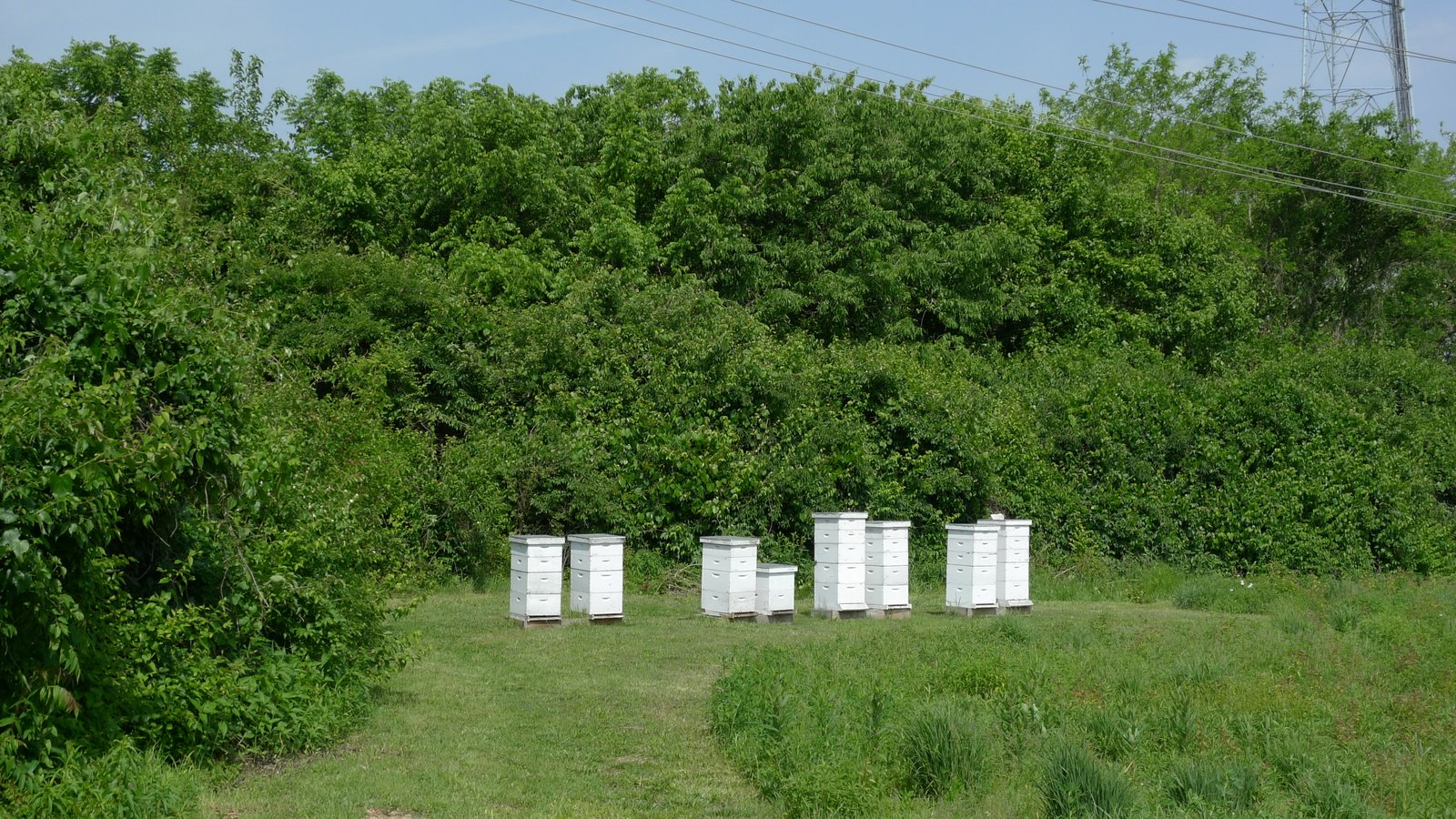
While in St. Louis last week, I visited the educational apiary of the Eastern Missouri Beekeepers Association (EMBA) with my friend Bob Sears, who is president of the association and was involved in establishing their apiary several years ago. Along with beekeeping classes, schools, and mentoring programs, association apiaries are, I’m convinced, an invaluable service that beekeeping associations can offer their members.

Easterm Missouri Beekeepers Assoc. Educational apiary

The Eastern Missouri beekeepers have developed an integrated educational program for new beekeepers, comprised of all of the programs I listed above. The association apiary is key to offering hands on instruction to the members, especially newer ones.  While it is possible to use members’ hives and apiaries in beekeeper education (as many groups do through Saturday afternoon field days), logically and educationally, it is far better to have a bee yard that is dedicated to education and is owned and maintained by the association. Continue reading