Author Archives: Phil Craft

My bees were after water today.

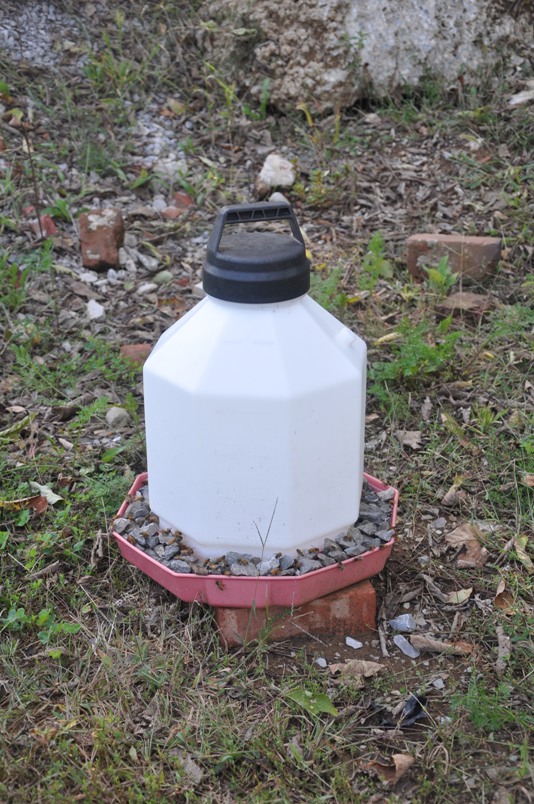
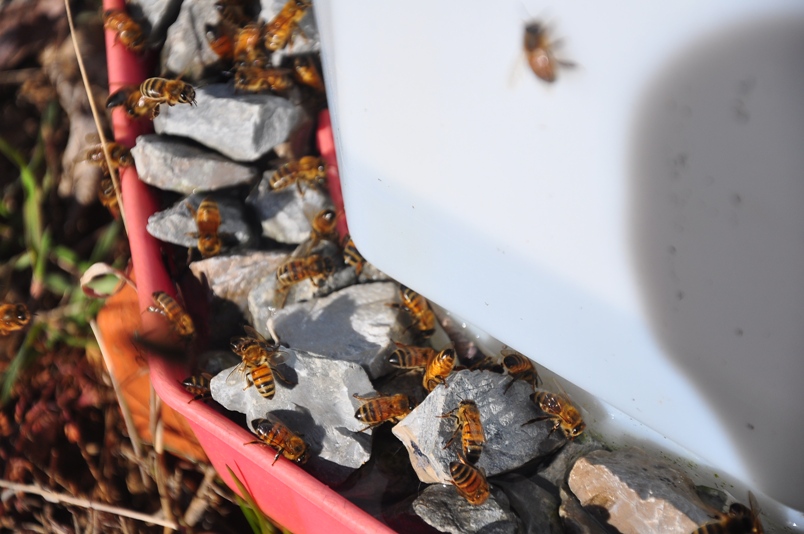
I have a chicken waterer set up in the front yard near my home beeyard to serve as a “honey bee waterer”. The girls were really taking advantage of it today! You may also view a short video clip of the action.
Phil

Click on the photo to see as a sharper image.


Kentucky sales tax on beekeeping equipment

House bill 136, a bill to remove Kentucky sales tax on beekeeping equipment, has been introduced in the Kentucky House of Representatives. For many years, Kentucky beekeepers have lamented that they must pay sales tax on beekeeping equipment, whereas other types of agricultural supplies are not taxed. HB136 is the latest of several attempts in recent years to gain a sales tax exemption for beekeepers. Leadership in the Kentucky State Beekeepers Association urges Kentucky beekeepers to contact their local state representatives and request that they support HB 136. However, the bill must first be approved by the Committee on Appropriations and Revenue. Thus, it is even more important to contact members of this committee, whether or not they represent your district, especially the chairman and vice-chairman. And time is short.

Exempting beekeeping equipment from sales tax is a bit more complicated than many believe. In Kentucky, there is no comprehensive tax exemption for agriculture. Rather, KRS 139.480, which is the Kentucky statute that authorizes exemptions to Kentucky sales taxes, is a hodgepodge of exemptions, only some of which are related to agriculture. Most of these exemptions have been added one by one, through legislation similar to HB 136. Beekeeping is not the only part of Kentucky agriculture not favored with an exemption; most equine related expenses are subject to Kentucky sales tax (though many sales of young horses are exempt). If you look at the bottom of KRS 139.480 you will see the numerous amendments and additions made over the years. Quite honestly, beekeepers have not been excluded from some favored tax status for agricultural supplies – they have just not successfully lobbied and pushed for a specific exemption. Unfortunately, this is the way the political game is played.

Kent’s patty recipe and some fondant recipes

In his article on the clustering behavior of honey bees, Kent mentioned making “patties”. Below is his patty recipe. Patties this time of year are intended as an emergency feeding for the bees. The recipe’s main ingredients are granulated sugar, some sugar syrup and a protein supplement such as Mega-bee, Feed Bee or Brood Builder .  Other ingredients mentioned role is to help attract the bees to the patties and add cost (Phil’s cheap). the companies that make the  protein supplements have recipes for use with their products at their webpages. Kent also warns about small hive beetles, any time you feed sugar syrup and protein or pollen you risk stimulating the laying of eggs by small hive beetles even in cold weather. You can also make bee candy and place over the top bars of the hives as emergency winter feeding of hives. Below Kent’s patty recipe are a couple of fondant recipes. For those you will need a candy thermometer.  You can find more fondant recipes on the internet; just put winter feeding of honey bees and fondant into a search engine. Be aware that bees will not break their cluster to take advantage of any winter emergency weather until it gets up into the 40s (F), but will go more quickly to food placed directly over the frames.

Kent Williams’ patty recipe
“The patties I use are made with 7 parts granulated sugar, 3 parts pollen sub, (I use Mega-Bee, but any powdered protein honey bee supplement will work) and one part syrup. The syrup is made by mixing 1 pint Honeybee healthy with 5 gallons of 1-1 sugar syrup, or straight hfcs (high fructose corn syrup – as sold by beekeeping supply companies) 55 or 42. For smaller amounts, this figures to around 3 tablespoons per quart, Honeybee Healthy to syrup. When I make the patties, I use a small cement mixer and mix 25 lb. sugar with 3 quarts mega-bee and one quart syrup. If beetles are an issue, I replace the HBH with a homemade mix containing wintergreen and lemongrass oils, but the same results can probably be reached by just adding a half dozen drops of wintergreen to each patty when placing it on the colony. Beetles may be attracted to the patties, but won’t be a real problem until the weather warms up, usually around mid-March in Western KY. (You can get too much wintergreen oil on the patties, which will result in the bees either evacuating the hive or being driven away from the patty.)

A small-batch fondant recipe
Mix 2 cups granulated sugar, 1.5 cups of water, 2 tablespoons corn syrup, and 1/8 teaspoon cream of tartar. Stir until sugar dissolves and continue to heat without stirring until the mixture reaches 238 degrees F. (Use a candy thermometer.) If you use bottled corn syrup from the grocery store, make sure it is “light” corn syrup, not “dark”. Dark corn syrup has molasses in it, which should not be fed to bees. Pour the mixture onto a cool surface and let it sit until cool enough to touch. Then beat the candy until it is thick and pour it into a thin container or mold, like a cookie sheet lined with wax paper, to harden. The candy can be broken up and placed over the inner cover. Alternatively, an empty honey super can be placed on top of the brood chamber and the candy placed on stick supports on the top of the brood bars. Some beekeepers will make a special small fondant feeder similar to an inner cover, but deeper (1 inch or more). The candy can be poured into this feeder and placed over the brood box upside down. Another recipe for larger batches calls for 15 lbs. sugar, 3 lbs. corn syrup, 4 cups water, and ½ tsp. cream of tartar. Make the candy in the same manner as the small-batch recipe. Cooking and beating are the keys.

The winter cluster of a honey bee colony, guest post from Kent Williams

A few days ago I received the most recent issue of Kent Williams’ Lake Barkley Beekeepers Association newsletter. This issue contained a very informative and well written account of the dynamics of the winter cluster of a honey bee colony. We’re almost to the time of year when I start getting the annual round of “why did my bees die” questions, and the answer always includes a discussion of the complexities of the winter cluster. Kent has graciously agreed to allow me to reprint his article in my philcrafthivecraft.com column. We’ll jump right into his article here, but you can read more about Kent at the end of the column.
Phil

Hello again, and welcome to the February edition of the LBBA newsletter. The calendar may indicate winter, but the maple trees on our place – and the honeybees that are working the maple blooms – believe spring has arrived. Our weather in western KY sometimes seems to mimic Forrest Gump’s box of chocolates – you never know what you’re going to get. Having lived here virtually all of my 52 years, my advice to bees and beekeepers alike is to not put the long-handles into storage just yet. The warm weather we have enjoyed for much of January and the beginning of February has allowed the bees to keep a loose cluster and both move within the hive to access food-stores and take advantage of any efforts made by beekeepers to provide supplemental feed for the colony. The (supposedly) ideal temperature for an overwintering colony is 45 degrees f. At this temperature, the bees will remain in a loose, but solid cluster, which will move throughout the hive to access food stores. As temperatures drop, there is a corresponding constriction, or compaction of the cluster. Continue reading

The story: New honey bee parasite discovered

I’ve been receiving emails from beekeepers asking about media reports concerning a fly that is attacking honey bees. These media reports are the result of recently published research from San Francisco State University. This research actually began in 2008 when  Biology Professor John Hafernik  picked up some dead honey bees from underneath lights outside his biology building at San Francisco State. He wasn’t really interested in the bees; he was just looking for some food for a praying mantis that he had found on a recent field trip. (Praying mantises, as you probably know, are carnivorous and feed on a variety of insects.) He left the dead bees sealed in a small bottle in his lab, and was surprised a few days later to find fly pupae along with the dead bees. These pupae were identified as Apocephalus borealis, a species of parasitic fly that commonly lays its eggs inside an insect host – usually bumble bees. This finding was the beginning of a trail that would lead to the discovery of a new honey bee parasite. Continue reading

Beekeeping education

The need for continued beekeeping education cannot be over stressed. I always tell those interested in beekeeping that taking care of honey bees is an entirely different type of animal husbandry. If we really think about it -really think about it – keeping an insect as a domesticated animal – though they are not actually domesticated – is downright strange.

Other livestock, such as horses, cows, goats, and pigs, are mammals. With mammals, we can look for some of the same symptoms that we look for in ourselves or our children when ill. For example, I have an old dog who is always underfoot in our house. Even though she can’t speak to tell me when something is wrong, her behavior communicates a great deal. Does she have a good appetite, or is she suddenly leaving food in her bowl? Is she active (at least as active as a 17 year old dog can be), or does she seem uninterested when I say the magic word? (The magic word is outside.) My wife thinks it’s gross, but I note her bowel movements. Do the feces look normal? These symptomatic behaviors strike a familiar chord. Continue reading

Thoughts on Beekeeping from Phil Craft

My first webpage column
This is, what I plan to be, the first of many columns I will write for this webpage. As I said in the About PCHC link, the column will be mostly about beekeeping but, like many beekeepers, as I learn more about honey bees, my interest in other insects grows, especially insects in Hymenoptera, the order in which taxonomy places honey bees. I also have an interest in other science related subjects – especially natural history. Expect some diversions into other realms. Also, those who persevere will most likely have to tolerate my occasional musings about other interests of mine, like books (on non-beekeeping as well as beekeeping topics), fly fishing, or my travels to our national parks. I do promise you that I won’t discuss politics or sports, though I enjoy the latter. Well, maybe, a little baseball – after all there are so many great baseball quotes, such as Yoga Berra’s “”Baseball is 90% mental — the other half is physical.” So be forewarned; sometimes I just can‘t help myself.

Also in About PCHC, I promised written beekeeping information sheets on various subjects, which I will write or solicit from others, to be downloadable by anyone at no charge. The site is somewhat sparse of those now, but they will appear as I write, re-write, or collect them. I will probably produce the sheets to provide additional or more in depth information about specific topics which I address initially in this column. I have already placed some beginning beekeeping information on the site, and plan to very shortly add more for potential and new beekeepers. I consider the subject of beginning beekeeping a timely seasonal topic in winter, as new beekeepers Continue reading

HAS 2012 date and location set

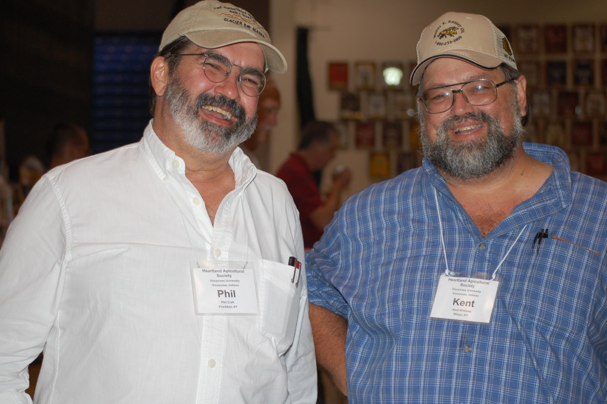
Phil Craft and Kent Williams at HAS 2011 - photo by Aretha Kees

HAS 2012 will be held at the University of Missouri – St Louis.  The dates are July 12-14. Tom Webster is putting the schedule together and organizers expect to have more details available soon at www.heartlandbees.org.