Author Archives: Phil Craft

HAS in St. Louis, May 5, 2012 – update

I returned last night from a quick trip to St. Louis for a tour of the University of Missouri in St. Louis, where the July 12-14, Heartland Apicultural Society (HAS) will be held. I had not previously visited the conference site, and I was very pleased with the facilities. Virtually all of the conference activities will take place at the J.C. Penney Conference Center, with the exception of the labs and apiary, which will both be within about 200 yards of the center.

I also met with a group of St. Louis beekeepers who will be organizing many of the conference activities. The energy level of this group is very high and I am looking forward to the conference. Progress on the program is on going, but some of the speakers who are planning to join us and whose names you will recognize are:  Jim Tew, Kim Flottum, Greg Hunt, Tom Webster, Michael Bush, and Stu Jacobson. I‘ll have more names for you soon. The popular queen rearing course will once again be part of the conference program. Watch the HAS webpage for speaker and program details. I hope to have a pre-registration form available for download from the site in the next week.

Pulled and extracted honey yesterday

I spent yesterday afternoon pulling and then extracting eight supers of honey. This is the earliest in the season I have ever harvested honey, and I could have taken this off at least a week ago. The honey is extremely light in color, the result of a heavy black locust bloom, the best in years, and of Asian bush honeysuckle, an invasive exotic shrub which is common here.

I’m off to St. Louis this morning to visit the University of Missouri in St. Louis, the planned site of this summer’s Heartland Apicultural Society Conference. Watch the HAS webpage for upcoming new information about this summer’s conference.

A Beekeepers Asks: Questions about missing queens and laying workers

A beekeeper asks:
About three weeks ago I caught a very large swarm and immediately placed it in two deep hive bodies with 10 frames in each. I looked in the hive today and found the top box was almost completely full of capped honey, lots of bees, but no brood. The bottom box, had some capped honey at the top corners of the frames, little pollen and two frames in the middle with some capped brood. I did not see the queen and my question is how to tell if a queen is present in the hive?

Phil’s reply:
I never worry about seeing the queen, unless I’m making nucs (I do not want to move her), re-queening, or doing a task where I really need her in hand. I depend on seeing eggs or larvae to determine her presence.

With this heavy nectar flow and a new swarm, you are not likely to see brood in both boxes, even with a big swarm. The bees are putting lots of nectar in now. If you are seeing eggs or larvae (uncapped brood) in the bottom box, you have a queen. Don’t worry about actually seeing her. If you look in the area (on these frames) where you are seeing the brood, that is the most likely place for her to be hanging out.

You may wish to put a honey super (or two) on that hive. I have 2 hives containing large swarms I have caught, which are putting honey in supers.

A beekeeper asks:
About three weeks ago I had a large swarm emerge from a hive (I saw and captured it). The top box in that hive is full of capped honey, but the bottom one is almost empty with only a few cells of capped brood. I did not see the queen. I’m concerned about the hive. Advice?

Phil’s reply:
You say there is some capped brood in the bottom hive body. That indicates that there was egg laying occurring less than three weeks ago, perhaps a few days longer if that is capped drone brood. It can take a hive between 2-3 weeks to produce a laying queen after it swarms and leaves capped queen cells. As I said in a recent post, queens emerge 7 to 8 days after the queen cells are capped. (And swarms will depart as soon as that happens.) Another week will pass before the virgin queen is ready to make her mating flights. During that time, she reaches sexual maturity and makes orientation flights. After successfully mating, she will start laying eggs in 2 to 3 days. Added up, it takes 2 to 3 weeks for the new queen to start laying eggs after a hive swarms. I would give it a few more days before considering installing a new queen. You may have a virgin, or a newly mated queen that has not yet started laying eggs.

I sometimes call this period, from just after the hive swarms until most of the brood in the hive emerges, a time of “apparent queenlessness”. It looks as though the colony is without a queen, but it may, in fact, be in the process of producing a new one. Many a beekeeper has contacted me at this time of year to tell me they thought a hive was queenless. They placed a queen in the hive or started to install one, and discovered eggs or young larvae. I advise patience before installing a replacement queen in a hive that seems to be queenless at this time of year.

A beekeeper asks:
I have a hive that has dwindled. There is a laying queen and I continually see eggs, but there is never brood. At one time I moved a frame of nurse bees into the hive, thinking that might be an issue, but it did not help. There are some capped drone cells which makes me wonder if the queen is not laying and workers are. The eggs seem normally positioned in the cells. Just curious what you thought.

Phil’s reply:
You may have a queen who has run out of sperm, so she is laying only drone eggs. (I have in the past called these infertile queens, but that doesn’t really sound right. They are fertile because they can lay eggs -just not fertilized eggs that develop into workers). Beekeepers often call them “drone layers”. With both laying workers and a queen that has run “dry”, you get only drone eggs. But if you’re seeing the queen, you probably do not have laying workers.

Laying workers is a condition that can develop in a hive after it becomes hopelessly queenless, when some of the workers respond to the lack of queen and brood pheromones by starting to lay eggs. Workers cannot mate, so when the do lay, the result is the same as when a queen dries – nothing but drone brood. Though workers are always capable of laying eggs, their urge to do so is suppressed by the pheromones present in a normal hive. Since brood pheromone plays a role in the suppression as well as pheromones from the queen, it takes several weeks for laying workers to develop even after the queen is gone. We can postpone this behavior by moving a frame or two of capped brood into a hive that has been queenless for a long period.

To help determine whether you have laying workers or a queen that has run out of sperm when you don’t see the queen and are finding only drone eggs, here is what to look for:

  • Laying workers: Only drone brood in the hive, and seen in worker sized cells; multiple eggs in a cell (always more than one laying worker in hive, so more than one of them may lay in a cell); the drone brood is scattered (they miss cells). The workers do not have the instinct to lay in every cell and to position the eggs properly.
  • Dry queen: Drone brood only, and seen in worker size cells; not scattered and no multiple eggs in cells. The queen is laying, just laying unfertilized eggs.

Nine frames or ten in the brood box?

I am often asked whether to use nine or ten frames in brood boxes. The answer is up to you, but here are my thoughts.

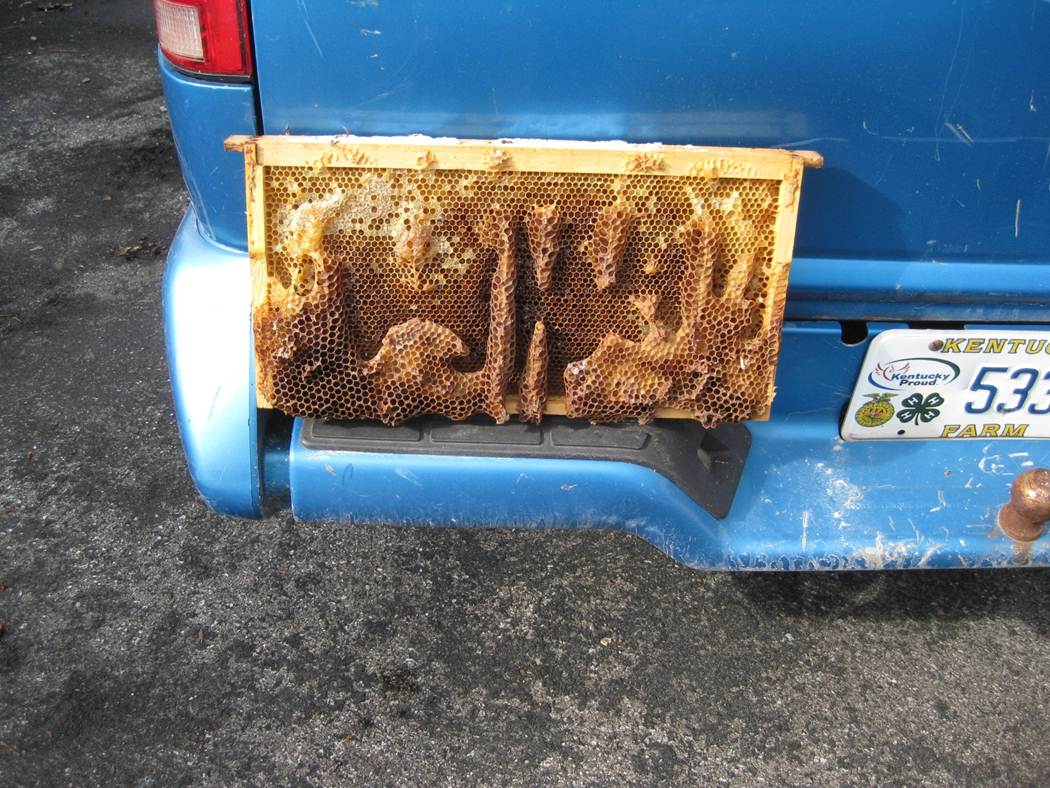
Conventional beekeeping boxes are designed for ten frames, which allows for the bee space (about 1/4”) between the combs when they are drawn out. Bee space is the largest gap that bees will leave as open space without trying to fill it with unwanted comb. I have often seen hives where the bee space has been violated, and the bees built an extra comb, often attaching two adjacent frames. It is messing with Mother Nature when we push the envelope on bee space, but beekeepers love to be innovative (or sloppy – I’m a sloppy old stick in the mud myself), so we push this limit all the time.

Fortunately, there is some wiggle room in the bee space concept. If we only remove one frame in the brood box and go to nine, keeping the remaining frames evenly spaced, the violation of the bee space is so slight that we can get by with it most of the time. Some beekeepers prefer to use nine frames because it leaves more room between the combs, making it easier to remove and replace frames.

However, it is important to ALWAYS keep these nine frames evenly spaced and ALWAYS, when starting brood boxes with frames containing new foundation, start with ten frames. If you wish to use nine ultimately, remove one when the comb on nine or ten of them has been drawn out. If you start with nine, the bees will often build that layer of extraneous comb right away.

Brood comb – a result of too much space between frames

Continue reading

A Tale of Two Nucs: post 4 – Checking on the new nucs

This weekend, I checked on the two nucs I set up a week ago.  Here are some of the things I looked for:

  • At this point in time, I am mostly concerned about the queens. Are they out of the queen cages and on a frame?
  • Do I still have plenty of bees on the frames? (Some of them will return to the hives I moved them from.)
  • Are the bees drawing out the frames of foundation I placed in the nucs when I set them up?
  • Are they taking the syrup from the feeder jars I placed in the hives?

I was pleased to find that the answer to last three questions was yes, and I refilled the feeder jars. However, I was not so fortunate on the first and most important issue.  In Nuc #2, the queen was released and on the comb; it is fine. In nuc #1,  I had messed up. I missed the presence of three queen cells on one of the brood frames. They were probably small and uncapped at the time, but their presence can interfere with the bees’ freeing and accepting the queen I had installed in the nuc. They are now capped queen cells. Continue reading

I’ll be keeping an eye on the queens inside my hives

I’ll start this post by saying that this an unusual spring here in Kentucky, so my beekeeping is a little off kilter. In more typical years, I put honey supers on in early to mid-April and do not see substantial nectar and honey storage until late April. This year, due to the mild winter and a spring that appeared to start in February, I put honey supers (with drawn comb) on in mid-March. That was a little early but, as you know, I was headed to the far side of the world on March 15th,  and I knew the supers would be needed earlier than usual. When I returned in early April, these hives were overflowing with bees and were already storing large amounts of nectar. I promptly added every super I had onto the hives. By mid-April I had some supers full of honey and now have hives with two supers or more each, full and capped. Next week I’m pulling them and extracting honey. That gives you an idea of the nectar flow here, but the story I was leading up to is the swarming. Continue reading

Heartland Apicultural Society conference to be held in St. Louis, Missouri, July 12 – 14th

The Heartland Apicultural Society (HAS) is a mid-west beekeeping organization dedicated to assisting beekeepers through education. This is accomplished by an annual, 3 day conference held at a different site each summer. The conference features plenary presentations by university research and extension speakers, classroom talks, and hands on “in the apiary” sessions. Presenters are not only the university folks and others whose articles you read in beekeeping magazines, but also experienced local beekeepers and  “regular” attendees (folks like Kent Williams from here in Kentucky, though some of these also write articles for the magazines).

This year’s conference will be held at the University of Missouri in St. Louis from July 12th through the 14th. A large vendor show is always part of the gathering, along with evening events, and tours to see sights in the St. Louis area. There will be college dormitory housing and meals available at an economical cost for participants. I expect this year’s meeting to be another GREAT learning opportunity and a fun experience for all that attend.

I served as HAS president in 2007, when the annual conference was last held in Kentucky, and as HAS chairman from 2008 – 20010. Due to my friendships in the HAS fold and in St. Louis, I have agreed to jump in and assist in working out the final details for this year’s conference.

Our goal is to get a list of some of the conference speakers up on the HAS webpage in the next few days, followed quickly by more detailed information and a pre-registration form. I will also be doing posts on this webpage to keep you informed as we proceed.

I will be traveling to St. Louis in the near future to look over the facilities for myself and to meet with volunteers there. If you live in the St. Louis area or plan to attend the conference and wish to help, please let me know.

Richard Underhill’s beekeeping posts from Ethiopia

If you enjoyed reading the posts from my trip to Bangladesh, you may also be interested in these from Richard Underhill  about his own recent beekeeping trip to Ethiopia. Richard is a beekeeper from Proctor, Arkansas, just across the river from Tennessee. He is past president of the Tennessee Beekeepers Association, current vice-president of the Arkansas State Beekeepers, and has attended Heartland Apicultural Society meetings and the Bluegrass Beekeeping School. I remember my wife typing in the registration forms for the bluegrass school and mentioning that we had someone coming from Arkansas. I said that, technically, he’s almost in Tennessee – depends on the current path of the Mississippi. At one of these meetings, Richard and I became aquainted. Over the years, I’ve enjoyed his friendship and his posts.

Like mine, Richard’s trip was organized by Winrock International. They have approached me about going to Africa as well – we’ll see. Richard’s posts of his Ethiopia trip can be found at his webpage. Just scroll down into March.  The Africa travels are not over for the Underhill family. Richard’s son Tod is presently in Ethiopia, on his own Winrock assignment.

Spoke at a beekeeping meeting in Tennessee last night, without leaving the house!

Last night I had a new experience. I spoke at a beekeeping meeting in Tennessee without leaving my old Kentucky home. This was accomplished via a video conference link coordinated by Barry Richards, the webmaster of this site. Barry is very good at the new high-tech stuff, and is doing his best to drag me into 21st century technology. When we first set up this webpage, Barry mentioned the possibility of doing presentations at beekeeping meetings by video conferencing, but I was not real excited about the possibility. Continue reading

A Tale of Two Hives: Following the progress of two new hives created from package bees – Post 6

Checking the hives, two week after installation
It has now been two weeks since I installed our two 3 pound packages of bees in their hives. Last week, at the one week mark, I was seeing drawn comb, nectar and/or sugar syrup (since we had feeders on, it’s hard to tell the difference), stored pollen, eggs, and larvae. I was also seeing more bees and drawn comb in hive #1, than in hive #2.

Today things in the hives appear to be progressing normally. There are more larvae (due to more eggs hatching since last week) and now I am seeing pupae (capped brood) as larvae from last week are maturing. To review the lifecycle of developing worker bees: eggs hatch about three days after being laid and start the development into larvae; larvae start to change into pupae about 5.5 days later (so about 8.5 days after being laid); and the bees will cap the cells about day nine after the eggs are laid.

There is more drawn comb in our hives and more brood in various stages of development. Obviously,there will not be an increase in the bee population until significant number of new bees start to emerge in a few weeks.

Newly drawn comb, honey and pollen

In the above photo, note the pattern of Continue reading