Author Archives: Phil Craft

A Tale of Two Nucs: Post 3 – Setting up the nucs

As I mentioned in post one of this series, the queens have arrived and I’m ready to set up nucs. Usually, I establish nucs with purchased queens or, occasionally, from an extra queen I have found in an existing hive. (Yes, we sometimes find more than one queen in a hive.) I have also been known to use swarm or supersedure cells found in existing hives to provide queens in my nucs. I do not advocate setting up queenless nucs and allowing the bees to produce queens from eggs or young larvae. One reason is that this method sometimes produces poor quality queens, and sometimes none at all. Another is that the time required for the nuc to produce a laying queen from eggs or young larvae is over three weeks, compared to a few days with a purchased queen, and about a week and a half with capped queen cells. I want to see the population of the nuc grow quickly, not to wait weeks for the numbers to increase. If you add the three weeks it takes to rear a new queen from an egg and to get her laying, to three weeks for the new eggs to mature into young bees, you are waiting six weeks.

To set up nucs we need a nuc box or a hive. A nuc box is just a small hive used for the convenience of the beekeeper; the bees do not care about the size of the box. Five frame boxes are most common, Continue reading
Tale of Two Nucs: Post 2 – Why make and maintain nucs?

Many beekeepers use nuc production as a method of swarm control. By removing brood and bees from strong hives in the spring, before they begin swarm behavior, beekeepers can often keep the bees they have while simultaneously either increasing the number of their hives or producing nucs for sale. I also use them as a method of storing queens for later use, both for short term storage of multiple queens in a single nuc (a queen bank), and for individual queens in nucs which may be combined later with existing hives for queen replacement. In reality, I set up nucs from spring through mid-summer, as I have time, available queens, and strong hives to serve as a source of brood and bees, without a firm plan for how any individual nuc will be used in the future. By May or June I may have set up one nuc for every four or so hives in my apiary. Some of these will become full sized colonies, but others will be used for different purposes.

If I should discover that one of my hives has become queenless, I can have a new queen in that hive in ten minutes by combining an established nuc with the queenless hive. I also use the nucs as a source of replacements for aged and failing queens, and for queens producing offspring with undesirable genetic characteristics. Continue reading

Tonight’s episode of Kentucky Life on urban beekeeping in Louisville

My wife and I just finished watching tonight’s episode of KET’s Kentucky Life which included a segment on urban beekeeping. This episode was filmed last summer at the Louisville home of Lorie Jacobs and her husband Ted. I joined Ted and Lori, other members of the Kentuckiana Beekeepers Association (Lorie is president of this group), and Kentucky Life host Dave Suffett, for the filming.  If you missed tonight’s premier showing, it will replay tomorrow (Sunday, April 22nd) on KET at 3:30pm ET. You may view this episode online at the KET webpage.

Notice Dave’s demonstration of the gentleness of Laura & Ted’s bees with his bare hand – a close encounter of the first kind!

A Tale of Two Hives: Lighting and Using Your Smoker – Post 5

At some point when preparing to look in a new beekeeper’s hive, I always say, “Go ahead and light your smoker.” I often hear – even from people who have had bees for a year or more – “I always have trouble with that” or, “I can’t keep it lit.” Then we have a smoker lesson. This post will be our smoker lesson.

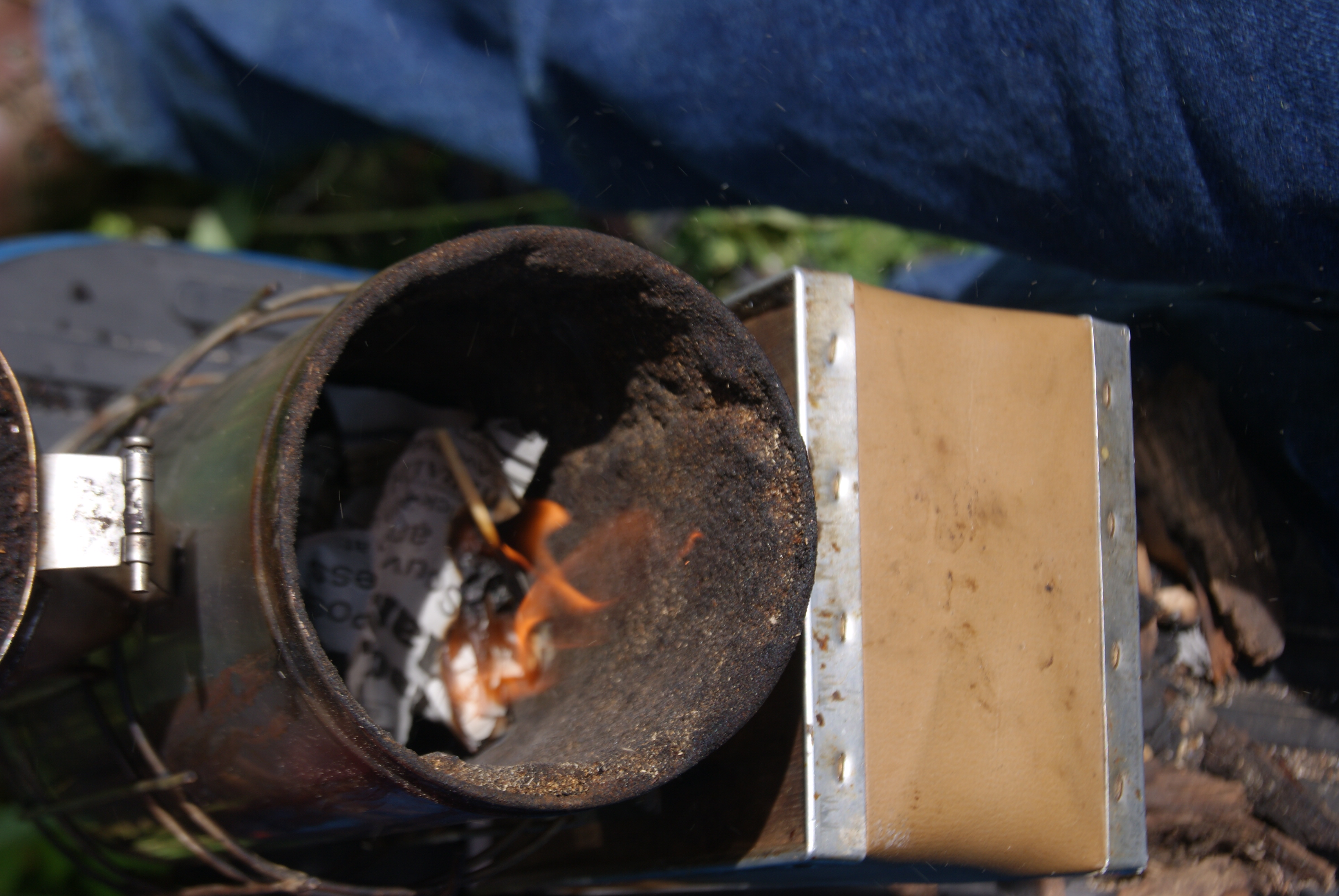
First step: lighting the smoker. Start by lighting the smoker when it is almost empty; do not try to light one full of fuel. I wad up a piece of newspaper (about one forth of a double page sheet), place it in the bottom of the smoker, and use a large kitchen match to light the paper. Then I place another, similar size piece of paper on top of the lit one. The hive tool is handy for moving lit materials around inside the smoker. Next, I add my starter fuel – in this case, wood chips. I sprinkle a handful  on top of the lit paper. (If you just dump them in, the flaming paper may go out.) I wait a minute, to let the wood chips ignite, then Continue reading

A Tale of Two Nucs: Post 1 – Prologue

My queen shipment has arrived, and I will start making nucs tomorrow. The first post in A Tale of Two Nucs will follow shortly. As I mentioned earlier, this series will begin with the making of two nucs and will follow them until they are established. For new beekeepers, think of a nuc as a starter hive, set up with several frames taken from an existing hive. These frames contain drawn comb with bees, pupae (final stage of developing bees), honey, and pollen – a bit of everything a colony needs, except a queen. She is added separately, usually in a queen cage.

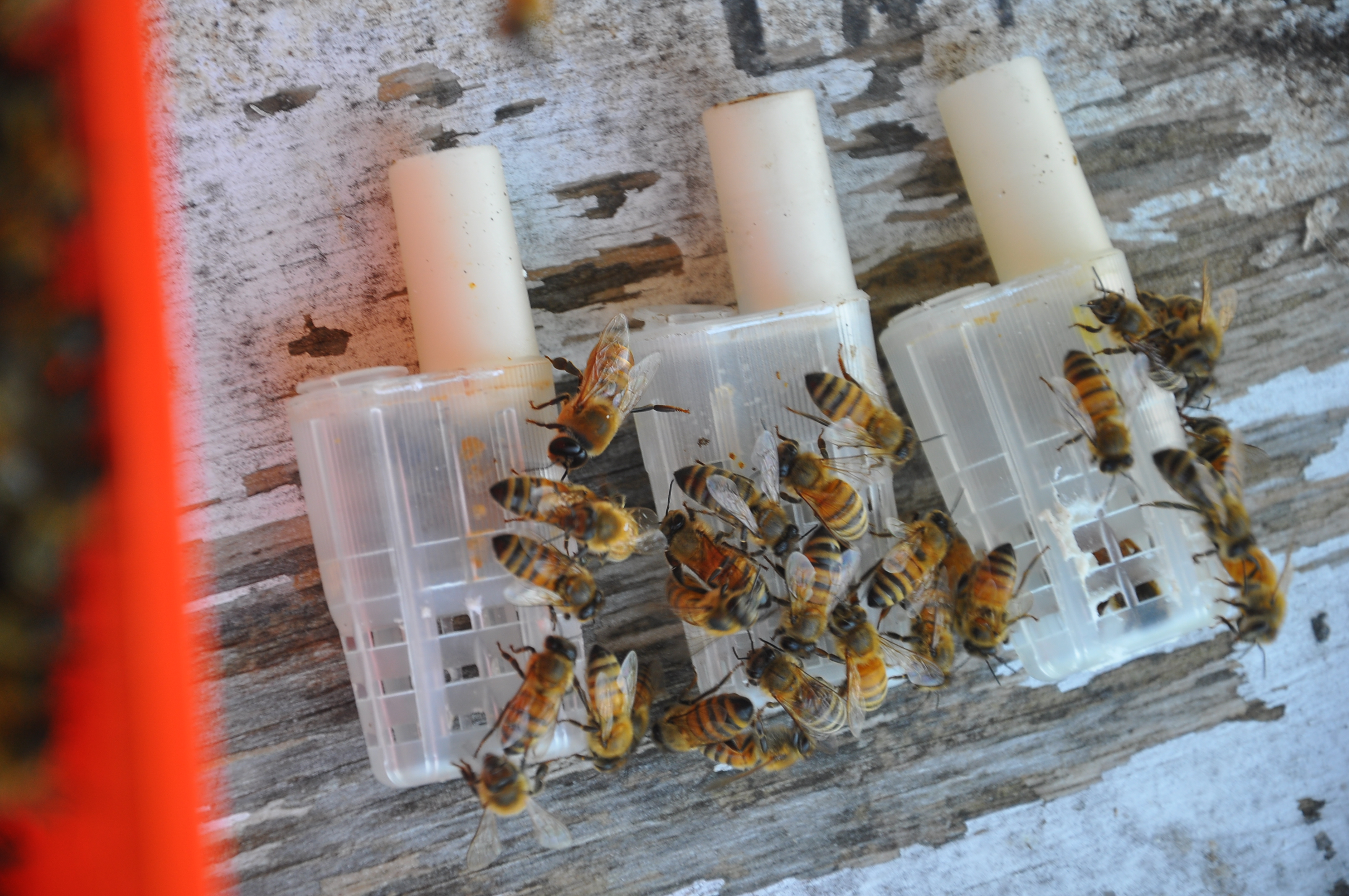
My queens arrived in a device called a battery, a method used for shipping several at a time, usually 15 or more. The queen cages, either wood or plastic, are the same as for queens shipped individually. The difference is in the attendant bees. In a battery, there are no attendants in the cages, each of which contains a solitary queen.

The queen cages are placed in a cardboard box (typical if the queen cages are wood) or in a plastic container (if the cages are plastic), and the attendant bees (from 25 to 100, depending on the number of queens in the shipment) are in outer containers, or battery boxes. Continue reading

Recent beekeeping articles in the media – April 4, 2012

Bees and beekeeping have made the headlines in several newspaper articles recently. Below are links and some brief information about the articles. A more complete listing of beekeeping in the media can be found on this webpage. I encourage beekeepers to send me links to media articles concerning beekeeping so that I can let others know about them.

On Saturday, April 21st, at 8:00pm, Kentucky Educational Television  (KET), will feature Louisville beekeepers Lorie and Ted Jacobs in an episode of Kentucky Life. You can read more about the episode in a recent article in the Louisville Courier Journal.

Former State Apiarist Phil Craft, was the subject of an article in the Jessamine Journal . The article discusses beekeeping and Phil’s recent activities, including his participation in five regional beekeeping schools at which he was a speaker (not host, as the article erroneously stated).

Several publications discussed the recent confirmation of Africanized bees in Tennessee. This discovery was the subject of a recent post on this webpage. Links to three of these publications can be found there.

Kentucky Department of Agriculture  Commissioner James Comer continues to invite controversy with his handling of the state apiarist position as reported in a Lexington Herald Leader article this week.


A beekeeper asks: New hive, when to install a second box and honey super? Do I keep feeding? Medications?

Phil
I installed my package last week. I have just one deep hive with a top feeder. When do I put on more hive sections and supers? Do I keep feeding? Do I need to medicate?
Dennis

Dennis,
Let them draw out about 7-8 frames in the first deep brood box, then add the 2nd brood box. After they draw out 7-8 frames in the second brood box you can add a honey super.

See my earlier posts on medicating & feeding. I do recommend the feeding of ½ gallon to 1 gallon of sugar syrup containing the antibiotic fumagillin. I recommend no other medications at this time. I’ll discuss other disease and pest issues in future posts.

Keep feeding as long as they will take syrup while drawing out the brood frames. However, I’m finding they are not taking syrup as readily as in past years due to the VERY strong nectar flow we are having.

But once you add a honey super you must stop feeding sugar syrup. You only want pure nectar in the honey super frames; sugar syrup does not become honey.
Phil

A beekeeper asks: Why aren’t there bees on my locust trees?

Phil
My hives are practically surrounded by black locust trees in full bloom, yet I’ve never seen a bee or any other bug around those blossoms. I noticed the same thing the last couple of years. The bees are in a major nectar flow right now, but is it not the locust?
Dave

Dave,
Two things can be going on.

One is time of day. Many plants only produce nectar for a short time of day. So you might not be looking at the blossoms at the right time of day.

Black locust tree

The other issue is quantity of nectar or plants available. You see this with clover a lot – nice clover bloom, but no bees on it. The bees would rather work a large patch of a single flower species rather than a small one, because we’re talking tens or hundreds of thousands of bees. So you have what you think is a nice patch of 15 locust trees, but a quarter of a mile away is a patch of 40 trees. Of course bees tell each other (through the dance language) where those patches are, and they communicate only the very good sources of nectar.


Black locust blossom

Another, related factor is that this year we seem to have everything blooming at one time. I’m seeing a lot of locust bloom as well, and I hope my bees are working it because it makes a wonderful honey. However, just now, there is also a tremendous bloom of bush honeysuckle, which is a very invasive, non-native plant. (Unfortunately many good nectar sources fall into this category.) It is flowering profusely, and I am definitely seeing bees on it.

Sometimes they are just working a plant (same species or different species) that they can get more nectar from more quickly or efficiently.
Phil


A swarm that did not end up in the top of a tree!

I’m not been hearing a lot from beekeepers so far about swarming , but I suspect this is a heavy swarming year everywhere and not just at my apiary. I was talking on the phone Saturday evening with my bee keeping friend Larry (we were both on cell phones) and he sounded distracted. I asked him what he was doing and he said he was trying to find a queen in a swarm. Realizing that he had his head in bee hive, I told him good bye. But that prompted me to go to my apiary to look for swarms. I found a huge one, 20 feet up in cedar tree. The problem, in addition to the height, is that cedars are a real pain to retrieve swarms from because of all the branches and the prickly needles. I worked for an hour trying to get all the bees, and had only partly succeeded before dark. I told myself that they would still be there in the morning Continue reading

A Tale of Two Hives: Following the progress of two new hives created from package bees – post 4

Checking the hives, one week after installation
It has now been one full week since I installed the two new packages of bees in their new homes in my apiary. Until today, I have been cautious about removing frames from the hives and disturbing the new colonies. This is because of the presence of young queens and the disruption to the bees that occurred during their transportation and introduction into the hive. In circumstances like these, bees will sometimes enclose the queen in a “ball” of bees, killing her in the process. This behavior of “balling the queen” is not well understood, but sometimes occurs in times of stress in honey bee colonies. This is why I leave the bees alone, with the exception of removing the queen cage and replenishing sugar syrup supplies, in the first week after installing the new package. I apply the same one week moratorium when re-queening hives or setting up nucs.

I start my examination with hive #1. Hive #1 is the hive where I found the queen dead in her cage before I installed the package (see previous posts in this series), and subsequently found another queen in that hive, which had been loose in the package with the bees all along. Continue reading