Author Archives: Phil Craft

Mid-summer Hive Inspections – They are Important

This is part 1 of a two part post; part 2 will follow soon.

It is mid-summer, it is hot, and I for one don’t find opening hives to be much fun this time of year. The bees are sometimes grumpier, but mostly it is just the heat. I work bees in my regular summer work clothes (jeans and a t-shirt) along with a veil, and I find it pretty warm. Consider that many beekeepers, especially newer ones, feeling a need for more protection against stings, suit up head to toe in coveralls. For them, it’s even hotter. Never-the-less, if you have not had a look down in the brood boxes for a while, it is time for a mid-summer inspection.

In a recent post I cautioned beekeepers about robbing behavior by honey bees. It’s important to keep that in mind when opening hives, especially in July and August. Because of the threat of robbing and discomfort from the heat, I keep my summer inspections brief – about five minutes. The object is not to look at every frame thoroughly, but to spend just enough time in the hive to make sure that all is well. Only if I find a problem or cannot assure myself by a quick inspection that the hive is healthy, will I prolong my visit or make a follow-up inspection at a later time. Usually I can learn what I need to know by looking at just a few frames in each brood box. Continue reading
Are Your Bees Doing the Washboard Dance on the Front of Your Hive?

Bees, in addition to just hanging out at the hive entrance, sometimes exhibit an even more interesting behavior called washboarding. This is a rhythmic movement, in which bees on the front of the hives (on the landing board and often above it) seem to step forward and backward,  swinging their front legs in what looks to me like a sweeping movement. In another era, when I was a child, my mother still sometimes made use of a washboard to do small batches of laundry by hand. (Her main laundry chores were done in an old fashion ringer washing machine.) This movement of the bees does remind me of the up and down movement my mother made on the washboard. However, I think it looks even more like a dance. Since the term “honey bee dance” is used to describe the movements of forager bees inside the hive on the face of the comb, I guess a new term was needed for this behavior. I find it interesting that only certain hives take part. Out of the 15 full, two story hives in my apiary, only two are exhibiting it at this time. One is shown in the video below. This raises multiple questions, why are they doing it, and why are only certain hives doing it? Is it weather related? Heat? Related to bearding on hives? Though long aware of this behavior, I had not noticed the bees in my apiary performing it earlier in the year. (I have observed it in years past.)

What are they doing? While many beekeepers believe that the bees are cleaning the surface of the hive near the entrance, I am not convinced. I do not know of any scientific research or evidence which shows that what they are doing is cleaning. If you are aware of any (a scientific paper), let me know. I did find one interesting article, co-authored by Dr. Jeff Pettis – head of the USDA Bee Research Lab in Beltsville, Maryland, discussing some of the scant research which has been done on this behavior, but the authors conclude that the reason for it is still unexplained.

See a little video I filmed this week of some of my girls doing their “washboard dance”, and turn up the sound. Washboard video.

Are Your Bees Hanging Out at the Entrance?

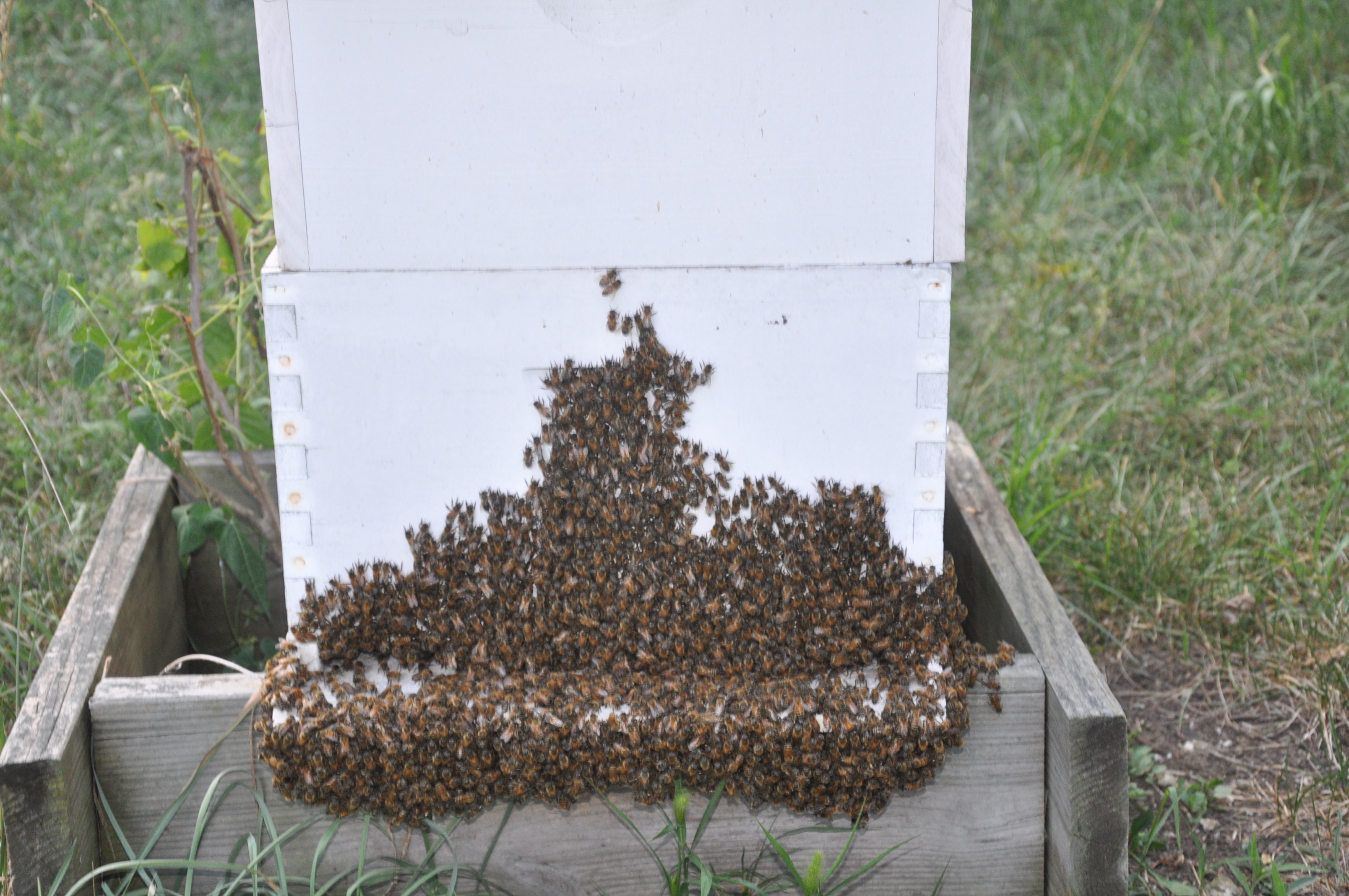
Do your hives have a lot of bees hanging near the entrance? This is a common behavior observed by beekeepers in the summer, especially in July when it is hot and the nectar flow has slowed down.

It is often called bearding and, when observed in July, should not be considered a precursor to swarming. If you are seeing this in your hives and are concerned that they are getting ready to move to a new location, calm down and take a deep breathe. Swarming is not imminent.

 I liken bearding to a human behavior from the days before air conditioning was common. It’s a sweltering Sunday afternoon, your chores are done, and the inside of the house feels like an oven. Where would you hang out? Why, on the front porch, of course. Some observations you can make to confirm that the behavior you’re seeing is bearding: fewer bees on the front of the hive in the cooler hours of morning and evening and on rainy days; more bees on the front of stronger hives. Stronger hives mean more bees, more body heat, and less room inside.

Recent trip to Bell Buckle,Tennessee

This post is only partly about beekeeping, but it does start out with beekeeping or, at least, honey. I recently received an invitation from my friends Ed and Elaine Holcombe to judge honey at their local county fair in Shelbyville, Tennessee. Ed is known for his beekeeping and queen rearing skills. He has worked with beekeepers in Croatia and Belarus as part of the USAID program and, in recent years, has been teaching beekeeping classes at Middle Tennessee State University. For the last several years, beekeepers in eastern Kentucky have benefited from his talks on maximizing honey production, which he has given at the Eastern Kentucky Beekeeping School in Hazard. Elaine is known for her skill in making candles and art objects from beeswax, as well as for sharing her interest and know-how with others. She has also taught classes at the Eastern Kentucky Beekeeping School. Ed’s and Elaine’s willingness to travel all the way to Hazard to help our beekeepers was a major factor in my deciding to accept their invitation to judge honey in Tennessee.

So last week my wife, Lee, and I headed to Tennessee for the Bedford County Fair and a visit with Ed and Elaine. Little did we know that the highlight of the trip was to have little to do with honey or beekeeping. Continue reading

Got Water? (Out for Your Bees)

If you’re reading this from Kentucky or the mid-west, you know it’s dry out there. Here at the home place we have gotten a little rain, but it is still pretty parched. A couple of weeks ago, if you had seen a picture of my bee yard, you might have imagined that it was October – grass brown and fallen leaves on the ground. Of course, if you were standing there in person in the 95°F heat, you would not have been fooled. Since then, we have received a couple of inches of rain. That has been a relief, though I could for more, but at least I am seeing some green in the yard.

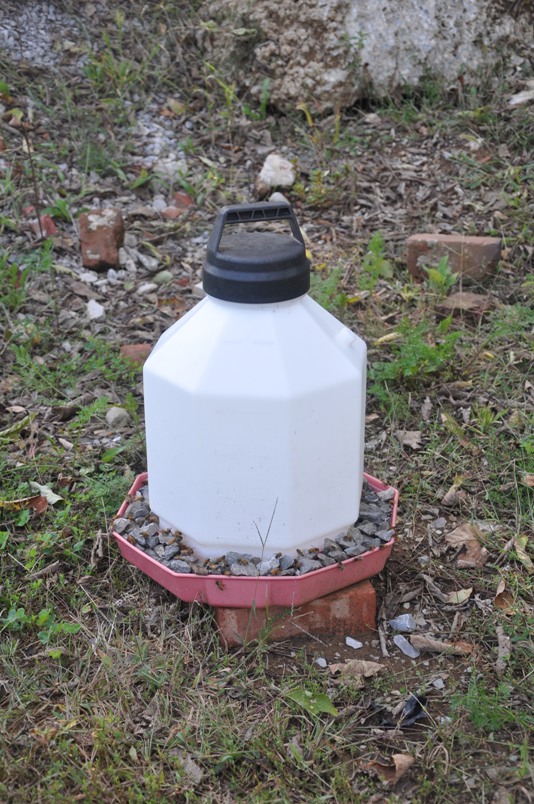
I’m also making a real effort to keep water in my “bee waterer”, which is seeing a lot of traffic lately.

If you’re interested, you can view a video clip of my bees at the watering station.

Fortunately, my neighbor across the road doesn’t have a swimming pool up this summer, but I am concerned that my girls are making a nuisance of themselves at someone else’s pool party. Continue reading

Removing Honey from Your Hive or Separating the Bees from Their Honey

A new task for novice beekeepers this time of year may be removing honey supers from the hives. Actually, removing them is pretty easy – just stick your hive tool under the corner of the honey super, break the seal (bees ALWAYS have it glued to whatever is underneath) and lift the super off. The trick is to get the bees out of the supers before you pry them off and to keep them out while getting the supers out of the apiary.

There are four methods commonly used by beekeepers to separate the bees from the honey. I’m going to concentrate on the last two methods, but briefly discuss the first two.

  • Bee blowers
  • Bee escapes
  • Shaking and brushing
  • Bee repellants

Continue reading

Keep an eye on your hives! I speak from experience, a recent one.

There is a real advantage to locating your beeyard close to the house. While I know that sometimes beekeepers need to have their hives in the back 40 or another remote location – kids, pets, neighbors, want them out of sight from thieves or vandals, etc. – there are real advantages to keeping the hives close at hand. I know from personal experience (I used to have an out-yard located several miles away) and I’ve seen it while visiting other beekeepers, if a beekeeper has to gather up beekeeping equipment, load a vehicle and drive to the apiary, the hives will not be checked on as often as they would if they are 100 feet away from the house.

Beekeepers with large numbers of hives have no choice in using out-yards since 15-20 hives is typically the most for one location. But for those of us with less than that number of hives, having them close can be a real advantage. If you are feeding hives or nucs, we have may have a 5-10 minute task if the hives are close, a half hour task if a drive is required. Continue reading

A beekeeper asks – Removing bees from a rotted hive

A beekeeper asks:
I have been given a colony of bees, it seems to be a very strong one, and it fills 3 deeps & a medium. My problem is it has been left undisturbed for about 8 years, the boxes & frames are rotting to the point of there being almost a 1 inch gap between some of the boxes, and as soon as you try to inspect a frame, the top falls apart. I truly think that beeswax & propolis are just about all that is holding the hive together.

How do I get the bees to move in to a new set of boxes without destroying the old hive in the process?

Phil’s reply:
While visiting beekeepers in Kentucky, I’ve observed this problem a number of times. Sometimes in hives, like yours, that had received no maintenance for years, most often abandoned hives that were falling apart from rot. I’ve also often run across hives containing frames that were not manipulated for so long that while the wood was still structurally sound, the frames were so glued together with propolis that the propolis bonds were stronger than the frames, with the same result – frames broke when an attempt was made to remove them. Both of these situations present the same problem, how to replace the frames or all the woodenware without tearing the hive apart and killing lots of bees? Continue reading

Honey Bees As Thieves? Robbing Is a Problem This Time of Year

Yes, our honey bees can become little criminals and steal from their neighbors! Their larceny is usually not much of a problem in the spring and early summer when a good nectar flow is on. But be alert! As the flow slows or stops, as is now occurring, bees are on the lookout for any source of food they can find. The closest source might be their neighbors’ hives. Weak hives (hives with decreased numbers of bees), new nucs or divides, recently captured swarms  – any hives that have not built up well or which are dwindling due to disease, pests, or other causes – are likely targets of robbing bees. Heavily robbed hives can face starvation very quickly, so beekeepers need to be observant to prevent or reduce this activity. The culprits may come from your own hives, from your neighbor’s, or from nearby bee trees.

A robbing response can also be triggered by beekeepers while working hives or removing honey supers at this time of year. Supers of honey, or even open brood boxes exposed in the bee yard, can be all the temptation that’s needed to initiate the behavior and, once begun, it quickly escalates. Try to go through hives quickly or cover boxes that are set off hives. When removing supers, take them out of your apiary as quickly as possible and keep them well covered if left temporarily outside. Continue reading

When should I remove honey from my hives?

As I expected, it has gotten very dry here in central Kentucky, bone dry, crunchy dry, no mowing grass dry, brown dry, dry! These conditions have brought an end to the nectar flow here and likely, in surrounding parts of the country. Many beekeepers are now extracting honey and many new beekeepers are contemplating removing their first honey crops. This post will commence several on removing, processing and bottling honey. In addition, as the nectar flow ends things are different in our hives. Our bees go from collecting and storing honey to eating honey, egg laying and brood production decreases, and problems with robbing increases. These changes present new challenges for our bees and management issues for beekeepers. I’ll write in detail about these issues in upcoming posts. Continue reading